
Field Notes from the Armoury
From Brief to Bulk: The Step-by-Step Process of a Fragrance Range
A fragrance range moves through six stages from brief to bulk, and every stage has exactly one deliverable: a signed brief, an approved scent reference, a standards statement, an approved decorated sample, a stability and safety conclusion, and a released batch with documents. Most projects that slip do not slip because the stages are hard. They slip because the deliverable of one stage was never defined, so the next stage quietly started on an unagreed input. This is the sequence and the gate at each step.
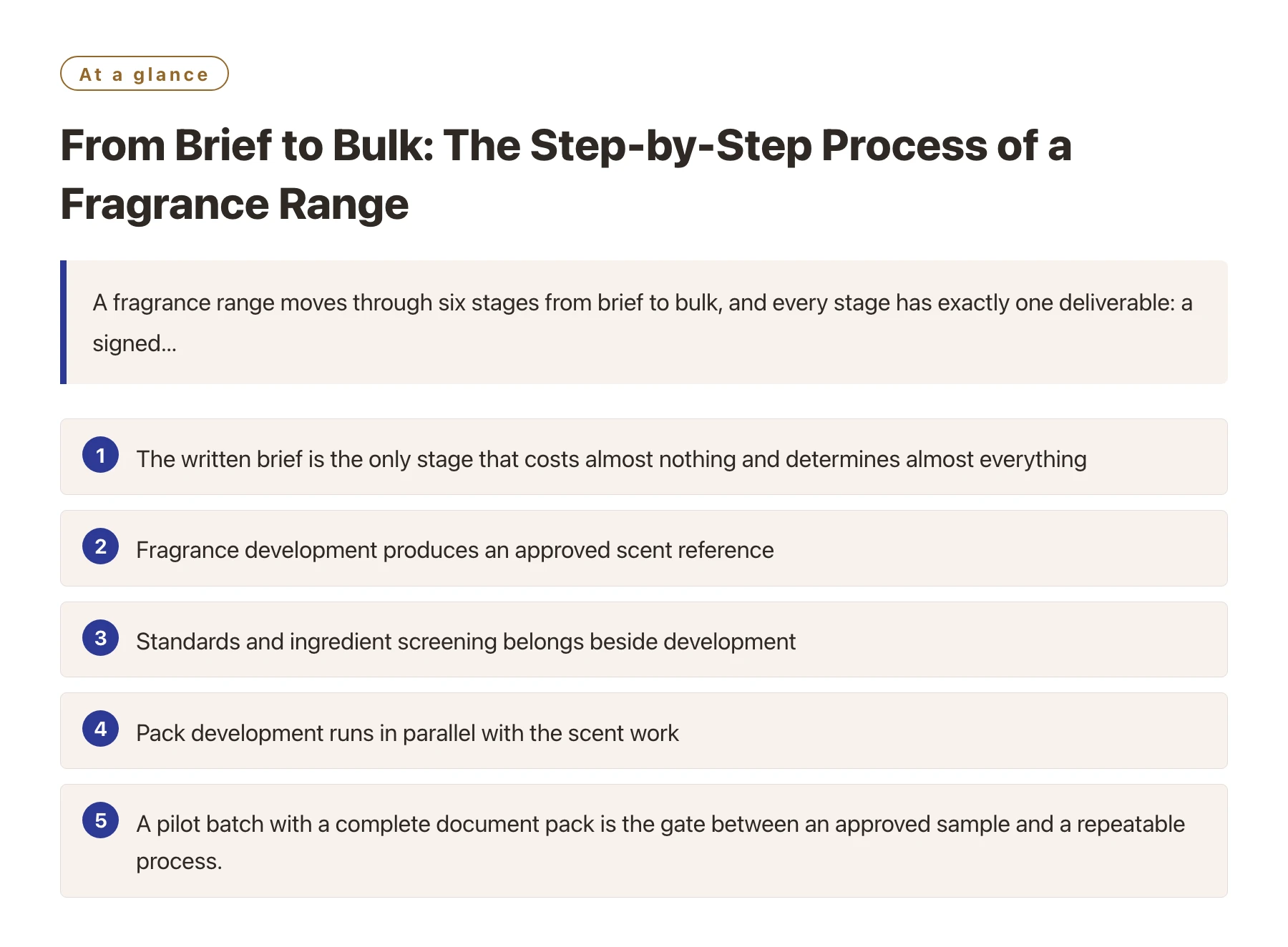
Key takeawaysThe written brief is the only stage that costs almost nothing and determines almost everything; most programmes skip it and pay later. · Fragrance development produces an approved scent reference, not a finished product — separate the scent decision from the base decision. · Standards and ingredient screening belongs beside development, not after the label is designed. · Pack development runs in parallel with the scent work, because the bottle and decoration carry the longest lead times. · A pilot batch with a complete document pack is the gate between an approved sample and a repeatable process.
Every fragrance programme is the same sequence underneath, whether the brand is launching three scents or thirty. What differs is how carefully each stage is gated. The product manager who knows which deliverable ends each stage gets a programme that moves; the one who lets the stages blur gets a programme that feels unpredictable.
This is the sequence as it actually runs, written as a working order rather than a theory.
Where most timelines go wrong
The most common failure is starting stage two before stage one is finished. A brief that says the brand is aiming for 'something fresh' is not a brief; it is a mood, and a mood produces five sampling rounds instead of two.
The second most common failure is sequencing that treats the scent as the only critical path. In practice the bottle, the closure and the decoration carry lead times as long as the formula work, and a programme that starts them late is late regardless of how fast the perfumer works — which is why a conversation with a development partner like Xuelei Perfume is worth having before the calendar is written.
The six stages, and the gate that ends each
- Brief and scope freezeDecide the SKU list, volumes, pack formats, destination markets and any claims in writing. The deliverable is a signed one-page brief. This stage takes days and decides most of the programme's cost and timeline.
- Fragrance developmentThe perfumer builds two or three directions from the brief. The gate is an approved scent reference held in two copies — not a finished product, not a photograph. A range with several SKUs usually shares one base and differentiates with dosage or a single note, which makes this gate simpler.
- Standards and ingredient screeningThe formulated concentrate is screened against the current standards of the fragrance industry's safety framework [1] and the ingredient rules of the destination markets, using the public ingredient databases those regulators maintain [2]. The gate is a written statement for the frozen formula version.
- Pack development in parallelWhile the scent iterates, the bottle, closure, decoration and carton are being quoted, tooled and sampled. The gate is an approved decorated sample with the artwork frozen. Delays here move the whole programme, because tooling has a calendar of its own.
- Stability and safety testingThe finished product is conditioned, tested and assessed with the exact dilution and pack that will ship. This stage cannot be shortened safely; a shortened test is a different product, not a faster one. Laboratories offering cosmetics testing run this work to the same GMP expectations as production [3].
- Pilot batch, document pack and releaseA small run on the real line proves filling, decoration and documentation together, and the batch records close the loop with the stage-two reference. The gate is a released batch plus the market document pack — the point at which the programme becomes repeatable.
The stages, their deliverables and their failure points
| Stage | Typical output | What can slip |
|---|---|---|
| Brief and scope | Signed one-page brief | Scope creep after sampling starts |
| Development | Approved scent reference | Endless rounds without a decision gate |
| Screening | Standards statement, frozen formula | Screening done after the label is designed |
| Pack development | Approved decorated sample | Artwork changes after the tooling order |
| Testing | Stability and safety conclusions | Conditioning time quietly shortened |
| Pilot and release | Released batch plus document pack | Shipping before the documents are ready |
Read the middle column as the contract. If a stage's output cannot be named, that stage is not finished — it is still running, and it is counting against the calendar.
Making the sequence work at range scale
A single product follows the same six stages as a range; the difference at scale is parallelism and gates. A well-run manufacturer runs the stages across several SKUs at once and reports progress per gate rather than per week.
For a brand, the practical consequence is that the whole chain — from idea through from formula to finished bottle — is only as strong as its weakest gate. That is why the evaluation of a development partner usually comes down to how they gate, which is what a manufacturer doing custom perfume production in China at scale will happily show you stage by stage.
Why the reference sample is the contract
The approved scent reference is the only object both sides can hold up against a later batch. Without it, every disagreement about whether the bulk order matches becomes a discussion about memory. With it, the discussion is a comparison.
Working with a house that runs the whole chain
A partner that combines development, manufacturing and its own scent museum and academy runs the six stages as one operation, which shortens the handoffs between the stages. Handoffs are where calendars leak; fewer handoffs, fewer leaks.
Name every gate before the programme starts. Write the six deliverables from the middle column on one page, add an owner and a date to each, and the programme manages itself for the next three months.
Sources
- IFRA Standards Library (International Fragrance Association) —— The IFRA Standards Library lists the restrictions the fragrance industry applies to individual fragrance ingredients, based on safety assessments; it is the reference point for compliant fragrance formulation.
- EU CosIng — Cosmetic Ingredient Database (European Commission) —— The European Commission's CosIng database of cosmetic ingredients, listing ingredient functions, restrictions and labelling requirements under EU cosmetics law.
- SGS: Cosmetics, Personal Care & Household Testing —— Testing, inspection and certification services for cosmetics and personal care, including microbiological, stability and safety testing aligned with cosmetics GMP.
Frequently asked questions
How long does the whole sequence take?
From a frozen brief to a released batch, most programmes run several months, with the stability and conditioning window the least flexible part. The stages in the middle — development, screening, pack — can run in parallel when the gates are respected.
What is the difference between an approved reference and a finished product?
The approved reference is the scent as agreed, held as a retained sample. The finished product is that scent in the final dilution and pack, proven by stability and safety testing. Skipping from the first to the last in one step is the classic source of surprise.
Why does the screening stage exist separately?
Because a formula that smells right can still be non-compliant. Screening the frozen formula against industry standards and market ingredient rules early is cheap; finding the conflict after the label is designed is expensive.
Can pack development really run in parallel with the scent?
Yes, as long as the fragrance concentration and product form are already fixed in the brief. The bottle does not depend on the scent; it depends on the format and the volume, which the brief decides.
What should the document pack contain at release?
At minimum: the batch record, the standards statement for the frozen formula, the stability and safety conclusions, and whatever the destination market requires for import and labelling. A released batch without the pack is a batch that cannot move.
Speak with a specialist
Our Tetbury team is on hand to verify your S/C or FAC and guide every rifle, shotgun and Section 5 enquiry — by appointment, in person, or by telephone.