
Referral Payout Mechanics: Timing and Thresholds
Settlement and payout are different events, and the gap between them is where most referral disputes come from. At 500 TH/s the pool credits about 0.00022430 BTC a day, worth $19.00 at a BTC price of $84,692 — but a PPS+ account sees that figure arrive in 24 hourly steps of roughly $0.79, while a PPLNS account sees it arrive in lumpy distributions once blocks reach six confirmations.

Key takeaways
- PPS+ settles against current difficulty and pays hourly; PPLNS distributes only after a block reaches 6 confirmations, weighted by a miner's share of pool hashrate across the last 5 difficulty rounds.
- On 500 TH/s, hourly PPS+ settlement is about 0.00000935 BTC — roughly $0.79 — per hour, which matters for reconciling cash flow even though the daily total is identical.
- Treating a payout as a single component for comparison, the listed 2% PPLNS fee is about $0.38 a day cheaper than the listed 4%/2% PPS+ split on 500 TH/s, in exchange for variance the miner carries.
- Timing changes when money is visible, not when it is earned: thresholds, withdrawal steps and conversion all sit after settlement and are the usual cause of a referral payment arriving later than expected.
Definitions first
Share. A hash that meets a target easier than the network's. Shares are not blocks; they are a statistically reliable sample of the work a machine is doing, which is what makes them payable.
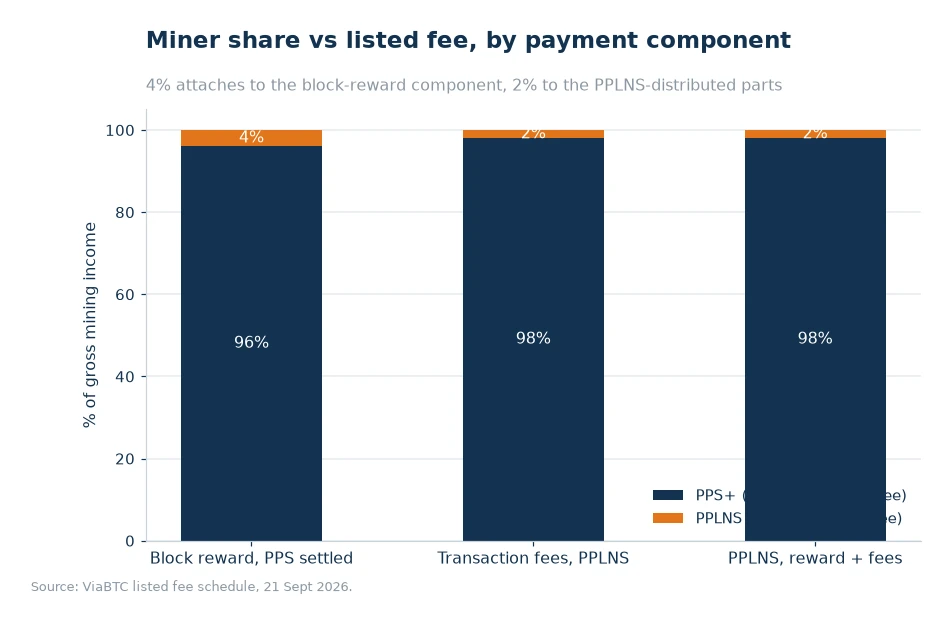
Listed fee. The percentage a pool publishes, and — crucially — the component it attaches to. PPS+ carries a listed 4% fee on the PPS-settled block-reward component and a listed 2% fee on the PPLNS-distributed transaction-fee component. PPLNS carries a listed 2% fee on block rewards and transaction fees together.[1] A pool's headline rate is meaningless without the second half of that sentence.
Settlement. The moment the pool calculates what a miner is owed for work already submitted. Under PPS+ that happens hourly against current difficulty; under PPLNS it happens when a block the pool found reaches six confirmations, measured over the last five difficulty rounds.
Payout threshold. The balance a miner must hold before funds can leave. It sits downstream of settlement, which is why a scheduled settlement and an on-time payment are not the same claim.
The trade-off nobody prices
PPS+ and PPLNS produce the same expected income from the same hashrate, because expected income depends on your share of network hashrate, not on the payment label. What differs is who absorbs variance and what that costs.
Under PPS+ the pool pays a theoretical reward for every valid share, so it carries pool-luck and orphaned-block risk and charges a higher listed fee on the block-reward component in return. Under PPLNS the miner receives distributions only when the pool finds blocks, so income is bumpier but the listed fee is lower and long-run averages are often a little higher. A referral relationship inherits that choice: a referred miner on PPS+ produces smoother, smaller fee amounts, while one on PPLNS produces lumpier amounts that track blocks rather than the clock.
The second unpriced cost is reconciliation effort. Hourly settlement means an account statement that lines up with an electricity bill day by day. Block-driven settlement means the same monthly total arrives in an unpredictable shape, which is harder to reconcile against any fixed cost. Neither is better; they fail differently.
| Stage | PPS+ (default) | PPLNS |
|---|---|---|
| Work credited as | Shares, against current difficulty | Shares, weighted over the last 5 difficulty rounds |
| Listed fee on block reward | 4% | 2% |
| Listed fee on transaction fees | 2% | 2% |
| Distribution event | Every hour | When a block found by the pool reaches 6 confirmations |
| Confirmation latency | None added to the hourly cycle | About one hour at a ten-minute block interval, before distribution |
| Variance carried by | The pool | The miner |
| Shape of a month | 24 equal steps a day | Irregular, block-driven amounts |
Example with two setups
Both setups run 500 TH/s at difficulty 132.76 T, where the network issues 450 BTC a day and network hashrate is about 1,003 EH/s. Gross production is 500 ÷ 1,003,107,267,295 × 450, which is 0.00022430 BTC a day, or $19.00 at $84,692.
Setup A — PPS+. The pool settles hourly. Each hourly step is 0.00000935 BTC, about $0.79, and the miner's balance grows 24 times a day. Net of the listed 4% fee on the block-reward component, the day is worth about $18.24. Nothing in that schedule depends on when the pool happens to find a block, so a cold streak at the pool does not change what the miner is owed.
Setup B — PPLNS. The same hashrate, delivered as distributions that begin after a found block reaches six confirmations. If the whole payout is treated as a single component for comparability, the listed 2% fee leaves $18.62 a day — about $0.38 more than Setup A, or roughly $11.40 over a month. In exchange, the miner's month arrives in irregular amounts: a quiet week at the pool is a quiet week on the statement.
The point of the comparison is not that one is better. It is that the difference between them is small enough that timing, thresholds and payout routes decide more than the headline rate does. A miner withdrawing small balances frequently on a rail that charges per transfer can give back more than the $0.38 a day the fee choice saved — which is why zero-fee mining payouts and an in-account multi-currency wallet matter to the ledger, not just the interface.
One mechanical detail is easy to miss and worth stating: a submitted mining pool account can hold balances in twenty or more assets, and conversion between them happens inside the same account. That removes a transfer step from the route between hashrate and spendable money, which is exactly the step where timing complaints usually originate.
Practical next steps
- Write down both events. For each method, note when work is credited and when funds can leave. If you cannot state the threshold, you cannot predict the arrival date.
- Reconcile against realised hashrate. Compare the credited hashrate with the nameplate figure. A persistent gap explains more late payments than pool mechanics do.
- Match cadence to obligations. If power invoices are monthly, hourly settlement mostly buys certainty. If they are weekly, hourly settlement actually buys liquidity.
- Set alerts before you need them. A mining app with real-time hashrate monitoring and notifications closes the gap between a dropped worker and a fix, which is the only timing problem a miner can directly control.
- Read the referral terms at the source. Eligibility, payment timing and thresholds are defined by the programme rather than by any summary; the applicable terms live on the ViaBTC Referral page.
Frequently asked questions
Can I mine more than one coin at the same time?
Yes. Merged mining lets a machine secure a parent chain and an auxiliary chain together, and multi-coin pools support switching between chains without moving hardware.
Do mining pools cost anything to join?
Joining is free; the pool earns from its fee on settled payouts, which appears as a percentage of the block-reward and transaction-fee components.
How long does a PPLNS payout take to arrive?
Distribution starts once a block found by the pool reaches six confirmations, which at a ten-minute block interval is roughly an hour of confirmation latency before the distribution event. The amount is then weighted by each miner's share of pool hashrate across the last five difficulty rounds. A payout threshold adds further delay after that.
The short version
Decide which risk you would rather hold, then check three things in order: what the listed fee attaches to, when settlement happens, and what stands between settlement and a completed payout. On 500 TH/s the fee choice is worth about $0.38 a day and the timing choice is worth a predictable statement. Get all three aligned with your obligations and referrals become boring, which is what a recurring payment should be.
Data and sources: ViaBTC pricing[1] and the ViaBTC fee breakdown[2]. Difficulty 132.76 T, network hashrate 1,003 EH/s and the BTC price of $84,692 were read from public chain data and market feeds on 21 September 2026. The PPLNS comparison treats the payout as a single component for comparability; actual fee amounts depend on the balance of block rewards and transaction fees.