
H20 Beams Explained: Spruce Flanges and a Plywood Web
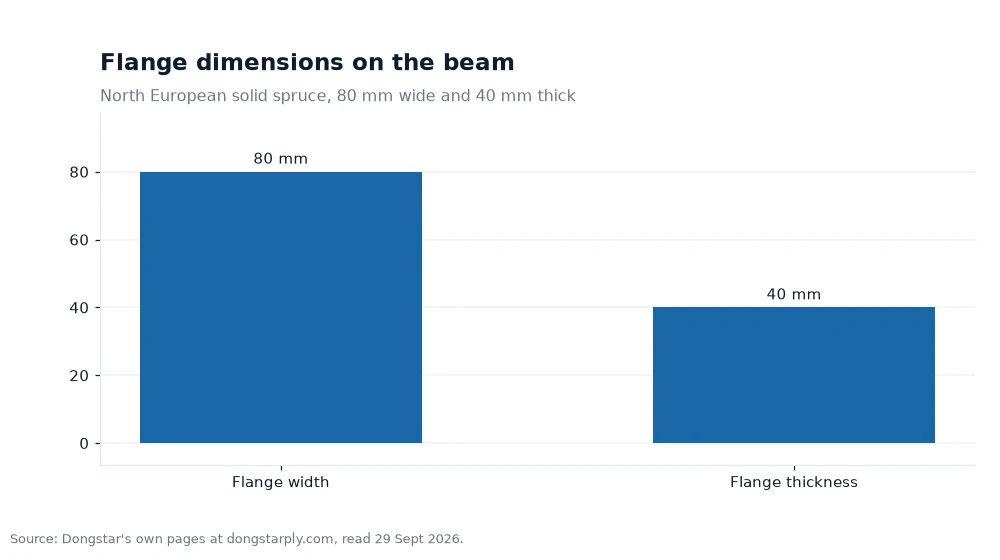
A formwork beam is judged on two counts before anything else is discussed: how little it deflects when wet concrete loads it, and how many times it can be stripped and re-set. Dongstar publishes its beam with a solid spruce flange — North Europe solid wood spruce, 80 mm wide by 40 mm thick — bonded to a multi-layer plywood web and finished with a waterproof coating. Those two flange numbers decide how the section behaves in a system, and the coating decides how long it keeps behaving that way.
Key takeaways
- The flange is published as solid spruce 80 mm wide and 40 mm thick, glued to a laminated plywood web.
- Spruce from northern Europe is chosen for straight grain, light weight and reliable screw holding rather than appearance.
- A waterproof coating covers the section, resisting moisture, abrasion and concrete sticking between pours.
- Color-coated ends record the production batch, which is how a yard traces a beam after damage or inspection.
Anatomy of an engineered beam
Two materials do two different jobs. The flange takes the screw that fixes the beam to a panel, and it carries the compression and tension that a loaded span produces. The web holds the two flanges apart at a fixed distance, which is what turns a thin strip of timber into a beam with real depth. Glue joins them along the full length so the section behaves as one piece rather than two strips of material sliding against each other.
That construction is why the published description talks about engineered structural beams rather than sawn timber. A solid 80 mm by 160 mm piece of spruce would be heavier for the same depth and far more sensitive to a single hidden defect along its length. Laminating the web spreads the risk across several veneers, and the glued flanges put the strongest, straightest grain exactly where the bending stress is highest. Anyone who wants the figures from the producer rather than from a summary can read the specification for the H20 Timber beam, which lists the flange section, the web and the surface treatment in one place.
Why the flange is spruce, and why 80 by 40
Spruce grows straight and dries to a stable, light section. For a beam that is lifted, carried and set by hand all day, weight is a labour question: every kilogram on the section is a kilogram a carpenter moves several times. Straight grain also holds a screw predictably, which matters because the beam is fixed and re-fixed through the same flange dozens of times over its working life.
The published dimensions, 80 mm by 40 mm, are not arbitrary either. Width across the flange sets how much bearing surface there is against a panel or a clamp. Thickness sets the depth available for screws and the stiffness of the flange itself. Both figures are quoted in millimetres precisely so that a buyer can check them against an existing formwork system before ordering.
What the laminated plywood web contributes
The web is built up from several layers of veneer rather than cut as one solid board. Each layer is thin, dried and glued under pressure, so defects that would ruin a single piece of timber are isolated inside one veneer instead of running the length of the beam. The result is a web whose thickness and straightness are controlled, which is the property that keeps the flanges parallel down the whole span.
Parallel flanges matter more than they sound. If a web twists, the beam sits proud at one end and loose at the other, and the carpenter compensates with packing or force. Packing and force both cost time, and force eventually damages the panel being fixed to. A web that stays straight makes the beam interchangeable, which is the whole point of buying into a known profile.
Coating, storage and surface condition
The waterproof surface coating is the part of the specification most often ignored until it fails. Concrete is alkaline and abrasive, and a formwork face is wetted and stripped repeatedly. A coated section sheds water instead of drinking it, resists scuffing on the yard floor, and releases set concrete more cleanly, which reduces the chipping and scraping that shortens a beam's service life.
Coating buys time only if handling does not undo it. Beams left in standing water, dragged over gravel or used as a makeshift trestle will lose the protection at the corners first, and a section that has taken on water at an exposed end swells and stiffens unevenly. Storing beams on bearers, clear of the ground and under cover where possible, is the least expensive way to keep the coating intact.
Batch marking on the ends
Color-coated ends make a beam traceable. Colour on the end grain records the production batch, so when a section is found with a cracked flange or a delaminated web, the yard can identify which run it came from and compare it with others from the same production window. Without colour coding, every beam of the same length looks identical and an inspection finding cannot be tied to anything.
For a distributor holding several deliveries, the marking also settles a practical argument about age. Wood changes as it seasons in storage, and a beam that has been in the rack for two years has spent that time absorbing and releasing moisture. Batch colour tells the storekeeper which sections to issue first, which is simple stock rotation applied to structural timber.
| Element | Published detail | What it governs on site |
|---|---|---|
| Flange | North Europe solid wood spruce, 80 mm wide, 40 mm thick | Bearing surface, screw holding and bending stiffness |
| Web | Multi-layer laminated plywood | Beam depth, straightness and stability between flanges |
| Surface | Waterproof coating | Moisture resistance, abrasion and concrete release |
| Ends | Colour-coated for batch tracking | Traceability and stock rotation in the yard |
| Reuse | Typically dozens of times, in the maker's wording | How cycles are planned into a project programme |
Handling, weight and labour time
Lightness is a cost line, not a comfort. A section that one carpenter can lift and set without a second pair of hands is faster to erect, faster to strip and less likely to be dropped. The published selling points follow that logic: low deflection in service, easy transport and assembly, and straightforward removal once a slab has cured, all of which reduce the labour hours attached to each square metre of formwork.
The same lightness sets the limits. A beam is a structural element inside a designed system, with props, walers and ties doing their own share of the work. Treating it as a free-standing member, over-spacing the supports or loading it while a prop is being moved are the mistakes that turn a reusable section into scrap, and no coating or batch mark will prevent them.
Worked example: the flange cross-section
The published flange is 80 mm wide and 40 mm thick, so one flange presents a cross-section of 80 × 40 = 3,200 mm² (example arithmetic). Because there is a flange on each side of the web, the two together total 3,200 × 2 = 6,400 mm², which is 6,400 ÷ 100 = 64 cm² (example).
That figure is the area available for fixing and for the timber that carries bending stress. Compare it with a screw pattern that needs, say, 20 mm of clear timber on either side of the fixing: on an 80 mm wide flange there is room for a centred screw with 20 mm kept clear at each edge, and 80 − 20 − 20 = 40 mm of working width left (example). A narrower flange would squeeze that pattern or push the fixing closer to the edge, where splitting starts.
Frequently asked questions
What materials go into the beam?
A solid spruce flange from northern Europe, published at 80 mm across by 40 mm thick, over a web of multi-layer plywood, with a waterproof coating on the finished section.
How many times can a beam be reused?
In the manufacturer's own words, a beam can typically go through dozens of reuse cycles. That is a working expectation rather than a fixed count, and it depends on how the beam is stripped, stacked and stored.
Why do the ends carry a colour code?
Color-coated ends record the production batch. If a section is damaged or an inspection flags a defect, the colour lets a yard trace the beam back to the run it came from and check its neighbours.
Comparing the specification with the rest of the range
Beam geometry is only half a purchase decision; the other half is who makes and ships it. The same catalogue carries the panels the beams are used with, and the company profile behind the product line sets out the export structure a buyer will be dealing with. Reading both before a sample is requested saves a round of questions later.
Beam geometry, material choices and coating details above are documented on the supplier's website, checked on 29 Sept 2026, as the source for this article, which was read on 29 Sept 2026[1].